Isher Engineering Works has always believed that understanding the roots of agricultural innovation helps us better appreciate modern farming technologies. One such groundbreaking invention that transformed global agriculture is the seed drill. We continue to respect and build upon these foundational ideas, as we provide advanced agricultural machinery inspired by time-tested innovations like the seed drill.
Where was the Seed Drill invented
The modern concept of the seed drill is most commonly associated with England. Although earlier versions existed in ancient China, where farmers used primitive drilling tools as early as the 2nd century BCE, it was the English agricultural pioneer Jethro Tull who refined and popularized the seed drill in the early 1700s.
Jethro Tull introduced a mechanical seed drill around 1701, which allowed seeds to be planted in neat rows at consistent depths. This invention arrived at a critical time, as Britain was facing growing population pressures and needed more efficient food production methods. The introduction of the seed drill during this period laid the foundation for the seed drill industrial revolution, helping agriculture keep pace with rapid industrial growth.
What did the seed drill to
The seed drill revolutionized farming by replacing manual sowing with a mechanical process. It did three essential things:
- Placed seeds at an optimal depth
- Ensured uniform spacing between seeds
- Covered seeds with soil to protect them from birds and wind
These improvements led to higher germination rates and stronger crop establishment. Farmers could cultivate larger areas with fewer laborers, saving both time and cost. The seed drill impact was not just technical but social and economic as well, as it improved food security and rural livelihoods.
Also Read : Potato Digger Machine Price in India
The Seed Drill and the Industrial Revolution
The seed drill industrial revolution connection is especially significant. As industries expanded and urban populations grew, the demand for food increased rapidly. Traditional farming methods could not meet this demand. The seed drill, along with other agricultural innovations, ensured consistent food supply to support industrial workers. Mechanized farming reduced dependency on manual labor, allowing rural workers to move to cities and work in factories.
Seed Drill Impact on Agriculture
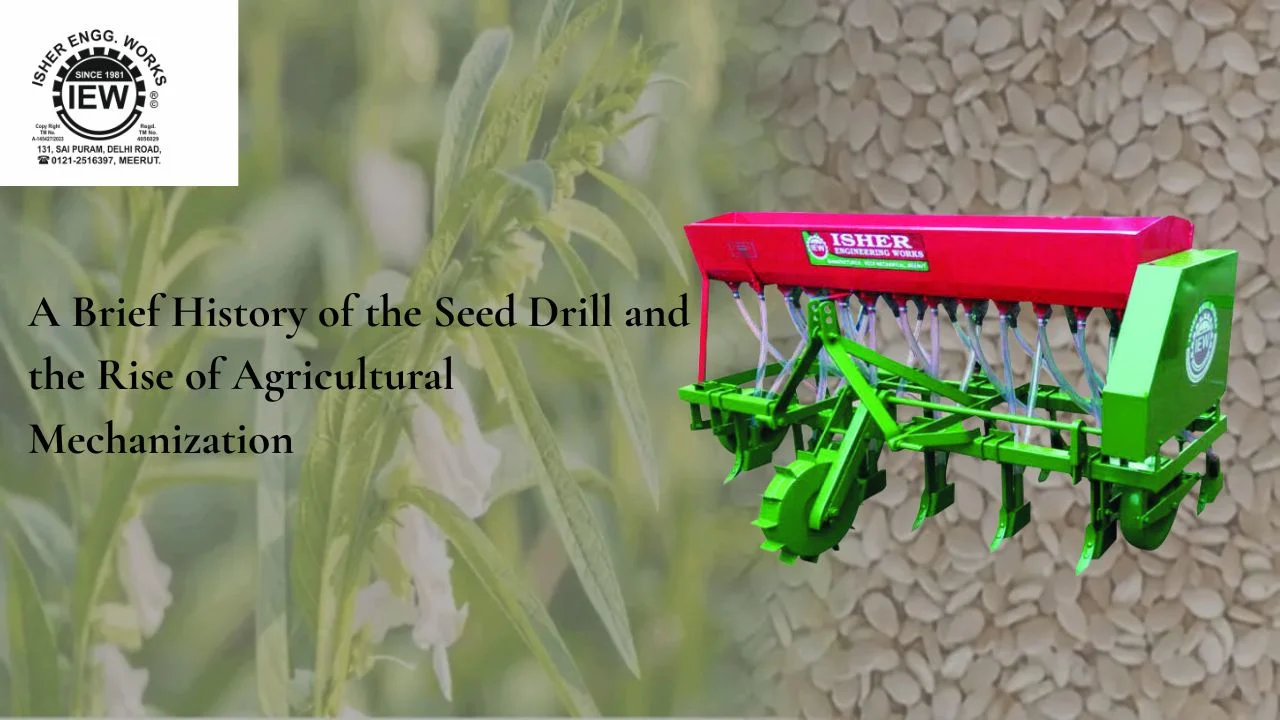
The seed drill impact can still be felt today. Modern seed drills are highly advanced, featuring precision controls, adjustable row spacing, and compatibility with tractors. However, the core principle remains the same as Jethro Tull’s original design: precise and efficient seed placement.
This innovation:
- Reduced seed wastage
- Increased crop yields
- Improved farm profitability
- Encouraged scientific farming practices
Even today, agricultural engineers study early seed drill designs to improve modern machinery. At Isher Engineering Works, we provide reliable and efficient agricultural equipment that reflects this legacy of innovation, combining traditional wisdom with modern engineering.
The history of the seed drill is a testament to how a single invention can change the course of human development. From its early roots to its refined role in the seed drill industrial revolution, and its lasting seed drill impact, this tool transformed agriculture forever.
At Isher Engineering Works, we honor this legacy by continuing to innovate and support farmers with dependable machinery. We proudly provide solutions inspired by historical breakthroughs like the seed drill, ensuring that agriculture remains productive, sustainable, and human-centered for generations to come.